The Ancient Cat of the High Steppes
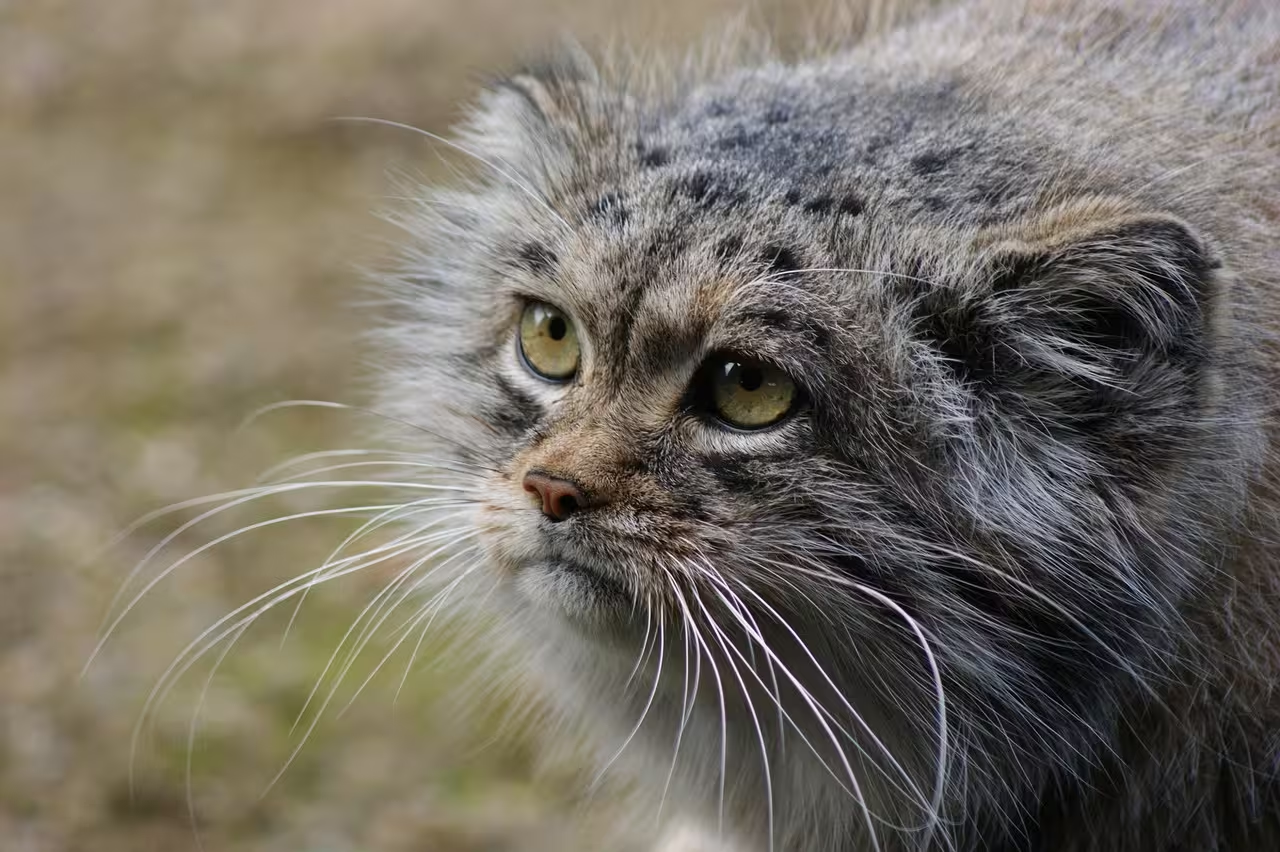
Did you know that the Pallas’s cat looks permanently grumpy because of its facial structure – not its mood? With its flat face, dense fur, and low-set ears, this small wild cat is perfectly adapted for survival in the harsh grasslands of Central Asia.
Unlike big cats, the Pallas’s cat survives not with speed or strength – but with camouflage and patience.
The Elusive Ghost of the Steppe
The Pallas’s cat, known scientifically as Otocolobus manul and commonly called the manul, is a small wild cat species found across the cold, dry steppes and rocky grasslands of Mongolia, Russia, China, and parts of Central Asia.
It represents one of the most ancient feline lineages on Earth, believed to have diverged from other wild cats millions of years ago. That evolutionary distance shows in features that set it apart from nearly every other small cat species – from its round pupils to its remarkably dense coat.
Currently classified as Near Threatened, the Pallas’s cat faces declining populations due to habitat degradation, prey decline, and increasing human disturbance across its remote range.
Physical Features and Unique Adaptations
The Pallas’s cat is a small animal by wild cat standards, weighing between 2.5 and 5 kilograms with a body length of 46 to 65 centimeters excluding the tail. In the wild, individuals typically live 8 to 12 years if they survive the vulnerable early months.
What makes this cat genuinely distinctive is its fur – one of the densest coats of any cat species anywhere. The winter coat in particular can contain up to 9,000 hairs per square centimeter, which allows it to survive temperatures that drop well below freezing across the high steppes and mountain grasslands it calls home.
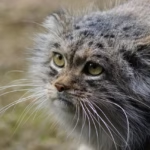
Its ears are set unusually low on the sides of its head, which helps it maintain a low profile when moving through open terrain. The flat face and wide-set eyes give it that famously grumpy expression that has made it an internet favourite, though the structure serves a practical purpose in reducing heat loss in extreme cold.
The round pupils are unusual among small cats, most of which have vertical slits. Its stocky body and relatively short legs keep it close to the ground, and the long fur makes it appear considerably larger and more substantial than its actual weight would suggest.
| Feature | Details |
|---|---|
| Weight | 2.5–5 kg |
| Body Length | 46–65 cm (excluding tail) |
| Lifespan | 8–12 years in wild |
| Fur Density | Up to 9,000 hairs per sq cm |
| Pupils | Round (unlike most small cats) |
| Conservation Status | Near Threatened (IUCN) |
Habitat and Range
The Pallas’s cat inhabits cold steppes, rocky grasslands, and semi-desert mountain regions across a range that stretches from Mongolia through southern Russia and into parts of China, Kazakhstan, and Kyrgyzstan. It avoids deep snow and dense forests, preferring open terrain with enough rocky cover to provide shelter and hunting ambush points.
The landscape it occupies is harsh by almost any standard – extreme seasonal temperature swings, limited water, sparse vegetation, and exposure to wind that nothing can escape. The Pallas’s cat has adapted to these conditions in ways that allow it to persist where many other small predators would fail.
Diet and Hunting Strategy
Unlike larger cats that rely on ambushing substantial prey, the Pallas’s cat specializes in small mammals that share its steppe habitat. Pikas form the core of its diet across most of its range, supplemented by voles, other small rodents, birds when opportunities arise, and occasionally insects during warmer months.
It is not a fast runner over any distance. Speed is not part of its survival toolkit. Instead, it relies on stealth, patience, and the kind of stillness that allows it to disappear against the rocks and dried grass of its surroundings. When threatened, it often freezes entirely rather than fleeing, trusting its camouflage to keep it invisible. When hunting, it stalks slowly and strikes in short, explosive bursts that cover only a few meters.
In an open landscape where cover is limited and visibility extends for long distances, this approach works better than attempting to outrun prey or predators across exposed ground.
Behavior and Social Structure
Pallas’s cats are solitary animals that come together only briefly during the mating season. They are most active at dawn and dusk, though they will hunt during daylight hours in winter when temperatures remain tolerable and prey activity peaks.
Because they are poor long-distance runners, they depend heavily on rocky crevices and abandoned marmot burrows for shelter and as escape routes from larger predators. Foxes, wolves, and large birds of prey all pose threats, particularly to younger or weaker individuals, and the Pallas’s cat survives in part by knowing exactly where the nearest refuge is at any given moment.
Breeding and Life Cycle
Mating occurs in late winter, and after a gestation period of around 66 to 75 days, females give birth to litters of two to six kittens. The young grow rapidly, which is critical in an environment where summers are short and the next winter arrives without mercy.
Kittens must reach a size and skill level that allows them to hunt and survive independently before the coldest months return. Those that do not mature quickly enough face extremely low survival odds.
Role in the Ecosystem
The Pallas’s cat plays an important but often overlooked role in maintaining the balance of steppe ecosystems. By controlling populations of pikas, voles, and other small rodents, it helps prevent the kind of population explosions that can degrade grassland vegetation and destabilize the broader food web.
In landscapes where larger predators are absent or rare, small carnivores like the Pallas’s cat become even more important in regulating prey species that would otherwise face few natural checks on their numbers. The health of the steppe depends in part on these quiet, largely invisible predators continuing to do what they have done for millions of years.
Where to See Pallas’s Cat in the Wild
Unlike rhino safaris in India or cheetah sightings in East Africa, Pallas’s cat encounters are extremely rare and unpredictable. There are no guarantees, no established viewing circuits, and no lodges built around regular sightings.
The best chances exist in the steppe regions of Mongolia, parts of southern Siberia, and across the Qinghai-Tibet Plateau in China. Even in these areas, sightings require luck, local knowledge, and a willingness to spend significant time in remote terrain with no certainty of success.
For most people interested in this species, seeing one in a well-managed wildlife facility may be the only realistic option. A handful of zoos worldwide maintain Pallas’s cat populations and contribute to research that benefits wild conservation efforts.
Conservation and Threats
The main threats facing the Pallas’s cat are habitat fragmentation, poisoning campaigns targeting rodents that eliminate its prey base, climate change that is altering steppe ecosystems in unpredictable ways, and increasing human activity in areas that were historically remote and undisturbed.
Because the species lives across such isolated terrain, obtaining accurate population data remains difficult. What is clear is that numbers are declining in areas where they were once stable, and the combination of threats is not improving.
Conservation efforts focus on habitat protection, reducing human-wildlife conflict, and better understanding the species through field research that is logistically challenging and expensive to conduct.
What Makes the Pallas’s Cat Remarkable
The Pallas’s cat has the densest fur of any wild cat, an adaptation that allows it to survive some of the coldest inhabited landscapes on Earth. It represents one of the oldest surviving wild cat lineages, having remained relatively unchanged for millions of years while other species evolved and disappeared around it.
It cannot roar like the big cats. It is highly sensitive to environmental change, which makes it a useful indicator species for the health of steppe ecosystems. And despite looking perpetually serious or even angry, that expression is simply the result of facial structure rather than temperament.
The Ancient Cat of the High Steppes
Did you know that the Pallas’s cat looks permanently grumpy because of its facial structure – not its mood? With its flat face, dense fur, and low-set ears, this small wild cat is perfectly adapted for survival in the harsh grasslands of Central Asia.
Unlike big cats, the Pallas’s cat survives not with speed or strength – but with camouflage and patience.