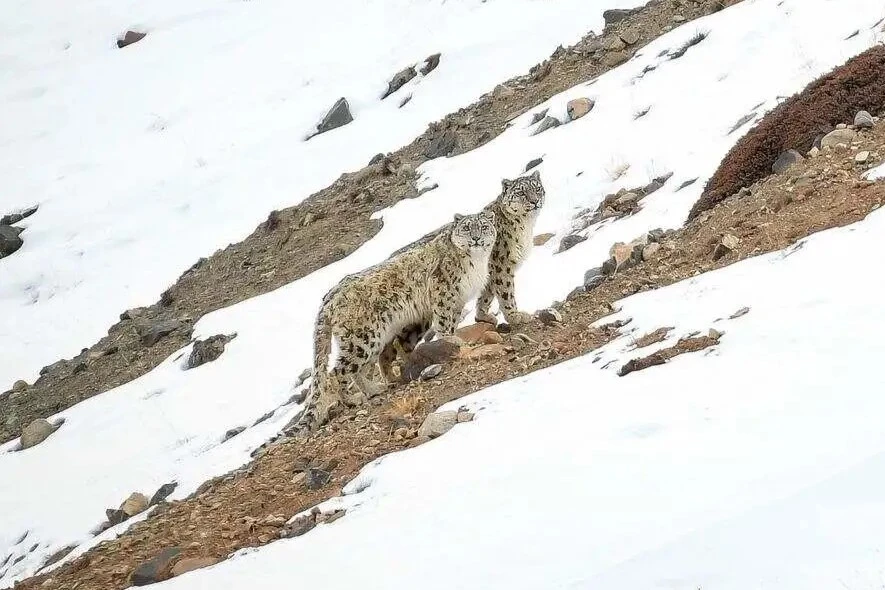
The Big Picture: Total Population
The Snow Leopard Population Assessment in India (SPAI) programme ran from 2019 to 2023. It covered almost 70% of potential snow leopard habitat across six states and union territories.
The survey used camera traps at 1,971 locations, running for nearly 180,000 trap nights. Researchers photographed 241 unique individual snow leopards. From that data, they estimated the total population at 718 animals.
This isn’t an exact headcount. It’s a scientific estimate based on where leopards were detected, habitat quality, and statistical modeling. The actual number could be slightly higher or lower, but 718 gives conservationists a solid reference point.
The survey covered Ladakh, Jammu and Kashmir, Himachal Pradesh, Uttarakhand, Sikkim, and Arunachal Pradesh. Together, these regions represent about 120,000 square kilometers of surveyed area.
State-by-State Breakdown
Ladakh – The Snow Leopard Capital
Ladakh holds 477 snow leopards. That’s 66% of India’s entire population.
This makes sense. Ladakh offers exactly what snow leopards need: high-altitude terrain above 2,700 meters, rugged mountains, and healthy populations of blue sheep and ibex. The trans-Himalayan landscape here is vast and relatively undisturbed.
The survey used 956 camera trap locations across Ladakh and photographed 126 unique individuals. The density estimate is 0.34 snow leopards per 100 square kilometers.
Regions like Hemis National Park, Rumbak Valley, and Ulley Valley fall within Ladakh’s snow leopard territory. These areas see regular sightings during winter months when leopards descend to lower elevations following prey.
Uttarakhand – Second Highest Population
Uttarakhand comes in second with 124 snow leopards.
The state set up 382 camera trap locations and captured images of 40 unique individuals. Density here is higher than Ladakh: 0.7 to 1.04 individuals per 100 square kilometers.
Key areas include the Gangotri-Govind landscape and Darma Valley. These protected regions maintain good prey populations and have strong community support for conservation.
The higher density suggests concentrated populations in specific valleys rather than leopards spread across vast areas like in Ladakh.
Himachal Pradesh
Himachal Pradesh has 51 snow leopards based on 284 camera trap locations and 44 unique individuals photographed.
Spiti Valley is the main stronghold here. The region around Kibber village has become famous for snow leopard sightings, with locals actively involved in conservation and ecotourism.
Density varies widely: 0.08 to 0.37 per 100 square kilometers. This variation reflects the mix of suitable and marginal habitat across the state.
Lahaul region also supports snow leopards, though numbers are lower than Spiti.
Arunachal Pradesh
Arunachal Pradesh recorded 36 snow leopards from 115 camera trap locations, capturing 8 unique individuals.
Density is 0.26 per 100 square kilometers. The eastern Himalayan habitat here differs from western regions. Less is known about snow leopard behavior and movements in this part of India.
The terrain is equally challenging but receives more precipitation than western ranges. This affects vegetation patterns and prey availability.
More survey work is needed here. The 36 estimate likely represents a minimum population rather than a complete count.
Sikkim
Sikkim’s count stands at 21 snow leopards. The survey used 99 camera trap locations and identified 14 unique individuals.
Density is 0.40 per 100 square kilometers. The Khangchendzonga landscape, including areas around India’s third-highest peak, provides prime habitat.
Sikkim’s small size means the population is concentrated. Community involvement here is strong, with local people participating in monitoring and conservation efforts.
The state has identified High Conservation Value areas specifically for protecting snow leopard habitat.
Jammu & Kashmir
Jammu and Kashmir has the smallest recorded population: 9 snow leopards.
The survey placed 135 camera traps and photographed 9 unique individuals. Density is relatively high at 0.75 per 100 square kilometers, but the total area of suitable habitat is limited.
Political and security situations have made comprehensive surveys difficult in some regions. The actual population might be higher, but current data is limited to accessible areas.
| State / UT | Camera Trap Locations | Unique Individuals Photographed | Density (per 100 km²) | Estimated Population | % of Total |
|---|---|---|---|---|---|
| Ladakh | 956 | 126 | 0.34 ± 0.14 | 477 | 66.4% |
| Uttarakhand | 382 | 40 | 0.7 – 1.04 | 124 | 17.3% |
| Himachal Pradesh | 284 | 44 | 0.08 – 0.37 | 51 | 7.1% |
| Arunachal Pradesh | 115 | 8 | 0.26 ± 0.11 | 36 | 5.0% |
| Sikkim | 99 | 14 | 0.40 ± 0.11 | 21 | 2.9% |
| Jammu & Kashmir | 135 | 9 | 0.75 ± 0.52 | 9 | 1.3% |
| TOTAL | 1,971 | 241 | – | 718 | 100% |
How the Survey Was Done
Camera Trap Method
Camera traps are motion-activated cameras placed along trails, ridges, and other routes snow leopards use. When an animal passes, the camera triggers and takes photos.
The SPAI programme deployed cameras at 1,971 locations. Each location ran for multiple days, totaling 180,000 trap nights. That’s one camera operating for one night.
Researchers photographed 241 unique individual snow leopards. Each leopard has unique spot patterns, like fingerprints. By comparing photos, experts can identify individual animals and avoid counting the same leopard twice.
This data feeds into statistical models that estimate how many leopards exist in areas without cameras, based on habitat quality and detection rates.
Survey Coverage
The survey covered 120,000 square kilometers. That represents about 70% of India’s potential snow leopard habitat.
Why not 100%? Some areas are too remote or dangerous to access safely. Others have ongoing border issues or security concerns. Weather conditions can also prevent survey teams from reaching certain regions.
The surveyed 70% includes most core habitat areas where snow leopard populations are believed to be strongest.
Two-Step Process
The survey followed a two-step approach based on 2019 guidelines from the Ministry of Environment, Forests and Climate Change.
Step one evaluated spatial distribution. Researchers mapped where snow leopards could potentially live based on habitat characteristics: altitude, terrain, prey availability, and human disturbance levels.
Step two assessed abundance using camera traps in those distribution ranges. This provided actual population estimates for areas with confirmed presence.
This method works well for rare, elusive species in difficult terrain. It’s more reliable than visual surveys or track counts, though still involves some estimation.
Limitations and Challenges
The terrain makes everything harder. Temperatures range from -40°C in winter to 30°C in summer. Equipment fails. Batteries die. Snow buries cameras.
Installing cameras at 4,000 to 5,500 meters altitude is physically demanding. Teams need multiple days just to reach some locations.
Snow leopards are solitary and cover huge territories. A single leopard might roam 100 square kilometers or more. Getting enough photos to identify individuals takes time and luck.
Weather can cancel weeks of planned survey work. Roads close. Passes become impassable. Teams get stuck waiting for conditions to improve.
Understanding the Numbers
Density Estimates
Density tells you how many snow leopards live in a given area. It’s expressed as individuals per 100 square kilometers.
Uttarakhand has the highest density: 0.7 to 1.04 per 100 km². This means concentrated populations in valleys with good prey and habitat.
Ladakh has lower density: 0.34 per 100 km². But the total area is massive, so the overall population is highest.
Himachal Pradesh shows the widest variation: 0.08 to 0.37 per 100 km². Some areas are excellent habitat, others are marginal.
Density depends on prey availability, terrain ruggedness, human disturbance, and how territories overlap. Lower density doesn’t necessarily mean worse habitat. It can reflect larger territories needed in areas where prey is more spread out.
Occupancy vs Population
The survey recorded occupancy across 94,000 square kilometers. That’s where cameras or other evidence confirmed snow leopard presence.
Estimated presence extends to 128,000 square kilometers based on habitat models. This includes suitable areas where leopards probably live but weren’t directly detected during the survey period.
The difference between these numbers shows potential. There’s room for population growth or expansion if conditions remain favorable.
Some suitable habitat currently shows no occupancy. This could mean leopards haven’t reached those areas yet, or they’re present at very low densities that the survey missed.
What These Numbers Mean
Population Status
Is 718 good? It’s hard to say without comparison data.
Globally, snow leopards are listed as Vulnerable. Total population across all 12 range countries is estimated at 4,000 to 6,500 individuals. India’s 718 represents roughly 11-18% of the global population.
The survey shows the population appears stable. There’s no evidence of widespread decline. Habitat loss and conflict issues exist, but haven’t collapsed populations yet.
Without previous comprehensive surveys, there’s no trend data. The population could be increasing, decreasing, or stable. The 718 number establishes the baseline for tracking future changes.
The Threats Behind the Numbers
Poaching and Illegal Trade
Snow leopards are killed for their fur and bones, which feed traditional medicine markets. Better enforcement has reduced this, but it still happens in remote areas where patrols are thin.
Human-Wildlife Conflict
The biggest threat in India.
When natural prey like bharal and ibex are scarce, snow leopards kill livestock. For poor herding communities, losing animals is devastating. The response is often retaliatory killing – a hard cycle to break.
Habitat Loss and Fragmentation
Roads, development, and infrastructure are pushing into the Himalayas. This breaks up habitat and isolates populations, leading to genetic problems and higher extinction risk.
Climate Change
The existential threat. Rising temperatures are pushing the tree line upward, replacing alpine meadows where prey animals live. Less habitat for prey means less habitat for snow leopards. Models suggest 30% habitat loss this century – and it’s already starting.
Prey Depletion
Overhunting and livestock competition reduce wild prey populations. When bharal and ibex numbers drop, snow leopards struggle to survive.
Why the Count Matters
Conservation Planning
The survey identified core zones where snow leopard populations are strongest. These areas need maximum protection.
Planners can now prioritize habitat protection based on actual occupancy data rather than assumptions. Resources go where they’ll have the biggest impact.
The data also reveals gaps. Areas between major populations need corridor protection so leopards can move between regions. Genetic diversity depends on connectivity.
Budget allocation becomes more rational. States with larger populations or critical habitat can receive proportionate funding.
Protection Status
Snow leopards already have strong legal protection in India. They’re listed in Schedule I of the Wildlife Protection Act, 1972. That’s the highest protection category, same as tigers.
They’re also in Appendix I of CITES, the Convention on International Trade in Endangered Species. This prohibits international commercial trade.
Ladakh designated the snow leopard as its official State Animal, giving additional symbolic and legal weight to conservation efforts.
But legal protection only works with enforcement and community support. The population data helps justify continued protection measures.
Conservation Efforts Making a Difference
Project Snow Leopard (2019)
India’s government initiative takes a landscape approach across all six snow leopard states. It focuses on habitat improvement, increasing prey, and reducing conflict through community involvement. Local people help with monitoring, benefit from ecotourism, and get support for livestock protection. Forest staff receive training in survey techniques and conflict management.
SECURE Himalaya Project (2017)
A collaboration between India’s Environment Ministry, UNDP, and the Global Environment Facility. The project trained 2,000 forest staff and community members in habitat monitoring, plus 1,000 women and youth in nature-based tourism. Fifty ecological studies identified High Conservation Value areas. Three became official Biodiversity Heritage Sites in Himachal Pradesh.
Community-Based Solutions
Predator-proof corrals – Reinforced enclosures keep livestock safe at night. Communities in Ladakh and Spiti have built hundreds using local materials and wire. They dramatically reduce losses.
Livestock insurance – When a snow leopard kills livestock, herders get compensated quickly. This removes the economic incentive for retaliation.
Community conservationists – Former herders now work as wildlife guides or monitors, turning adversaries into conservation partners.
Global Cooperation
The Global Snow Leopard and Ecosystem Protection Program (GSLEP) unites all 12 range countries – including Afghanistan, Bhutan, China, India, Kazakhstan, Kyrgyzstan, Mongolia, Nepal, Pakistan, Russia, Tajikistan, and Uzbekistan. Since snow leopards cross borders, their protection requires international coordination. India actively shares research and best practices through GSLEP.
Future Survey Plans
The remaining 30% of potential habitat needs surveying. Some areas may become accessible as security situations improve or technology advances.
Methodology will continue improving. Better cameras, longer battery life, and AI-assisted individual identification will make future surveys more efficient.
Regular monitoring cycles need establishing. Five to ten-year intervals would track population trends without excessive cost or disturbance.
Technology upgrades could include satellite collars for movement studies, genetic sampling for population health assessment, and drone surveys for terrain mapping.
Comparing to Other Big Cats
India conducts tiger censuses every four years. The 2022 count estimated 3,167 tigers. That’s much higher than snow leopards, but tigers live in more accessible habitat with higher prey density.
Asiatic lion population stands at around 674, all in Gujarat’s Gir Forest and surrounding areas. That’s remarkably close to the snow leopard count, though concentrated in a much smaller area.
Common leopard populations are harder to estimate nationwide but run into tens of thousands. Leopards adapt to diverse habitats from forests to farmland.
Snow leopards are harder to count than any of these. They live in the most extreme environments, at the lowest densities, in the most remote locations. Getting to 718 as an estimate represents significant achievement.
Final Thoughts
718 snow leopards is a number, but it’s also a story. It represents five years of work in brutal conditions by hundreds of researchers, forest staff, and community members.
It’s a starting point. The number will change. Populations fluctuate naturally. The goal is to ensure changes trend upward, or at minimum remain stable.
The population seems stable now. That’s good news. It means conservation efforts are working well enough to maintain what exists.
Community cooperation makes everything possible. Herders who lose livestock to snow leopards but don’t retaliate. Villagers who build corrals and participate in monitoring. Guides who lead tourists respectfully. Their support is what keeps 718 from becoming 400 or 200.
Long-term monitoring is essential. One survey establishes a baseline. Regular follow-ups track trends. Without continued effort, this data becomes historical rather than useful.
India has committed resources and attention to snow leopard conservation. Project Snow Leopard, SECURE Himalaya, and participation in GSLEP demonstrate that commitment.
The 718 snow leopards living in India’s mountains have a chance. With continued smart conservation, community involvement, and adequate funding, that number can hold or even grow.
The Himalayas are one of the last strongholds for this species. What happens here matters for the global population. India is doing its part.