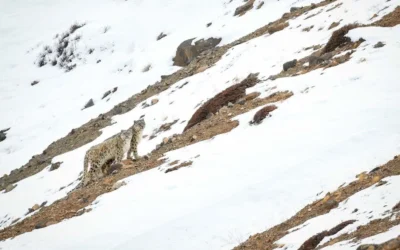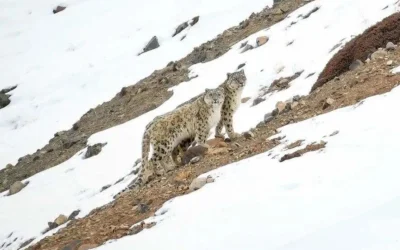
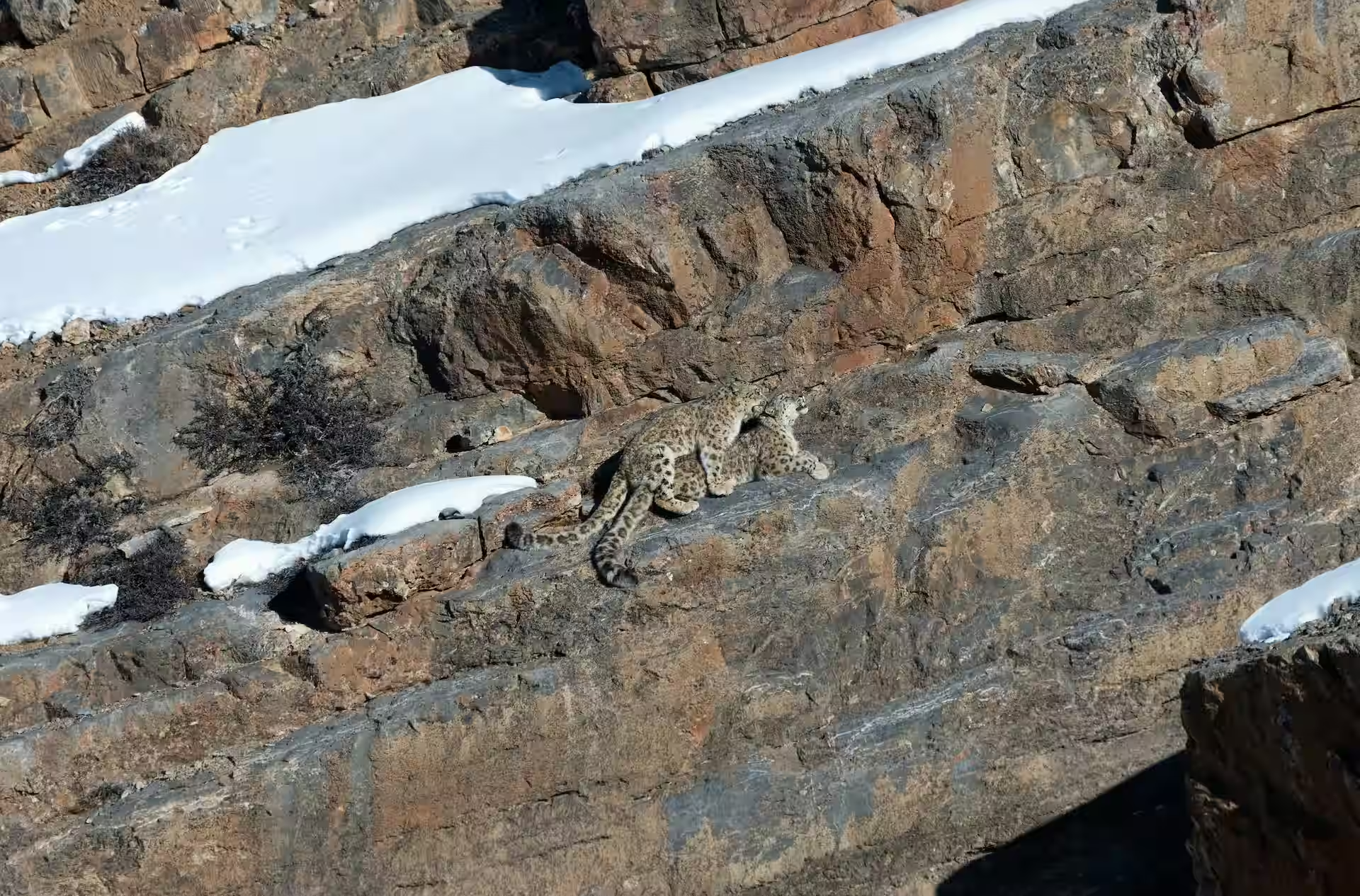
Imagine standing on a jagged ridge in the Himalayas, 14,000 feet above sea level. The air is thin, the wind is screaming, and all you see for miles is a sea of grey rock and blinding white snow. You’ve been staring at the same slope for hours, convinced it’s empty.
Then, a patch of “rock” suddenly stands up, shakes off the frost, and vanishes over a cliff.
You just met the Ghost of the Mountains.
Snow leopards are arguably the greatest hide-and-seek champions on the planet. Even for professional wildlife photographers and seasoned researchers, finding one can feel like looking for a needle in a haystack – if the needle was invisible and the haystack was the size of a mountain range.
Why are they so elusive?
It’s not just bad luck or their remote habitat; these big cats are biologically engineered to be ghosts. From their “pixelated” fur to their silent movement, here is why you can be looking right at a snow leopard and still not see it.
Their Coat is Perfect Camouflage
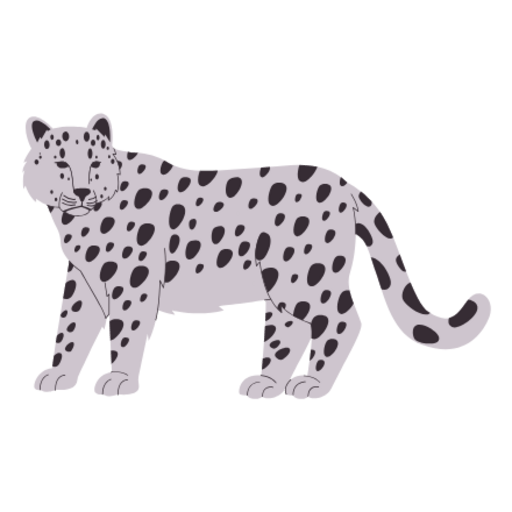
Their base coat is pale grey to cream. Their spots are dark rosettes arranged irregularly across the body. This combination replicates the exact visual texture of lichen-covered granite, patchy snow, and broken rock shadow.
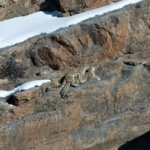
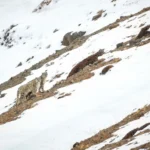
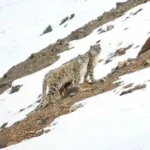
At 200 meters, a resting snow leopard on a rocky slope is nearly impossible to separate from the background. The spots break up the body outline. The grey tones match the rock. Even in open areas they disappear.
Experienced trackers talk about the moment a resting leopard suddenly “appears” after being invisible for minutes. It doesn’t move. Your brain just finally assembles the pattern correctly. That moment is startling every single time.
They Live in Extreme Terrain
Snow leopards occupy altitudes between 2,700 and 5,500 meters. Steep gorges, vertical cliff faces, boulder fields, and broken scree slopes. Places where a human needs both hands to climb and a snow leopard walks casually.
A snow leopard can cover ground in an hour that would take a fit tracker half a day. They move through areas completely inaccessible to survey teams and rest on ledges with no approach route.
At 4,500 meters, humans operate at roughly 60% of sea-level capacity. Walking uphill at that altitude carrying spotting scopes and camera gear in extreme cold is hard work. The terrain advantage belongs entirely to the leopard.
They Cover Huge Territories
A single snow leopard’s territory ranges from 100 to 1,000 square kilometers depending on prey availability and terrain.
In Hemis National Park, which covers about 4,400 square kilometers, there might be 30 to 40 resident snow leopards. On any given day, a specific leopard could be anywhere within its range. Trackers working a valley might be 15 kilometers from the nearest leopard without knowing it.
Seasonal movement adds complexity. Leopards follow blue sheep to lower elevations in winter and back up in summer. Understanding these shifts takes years of local observation.
They Are Naturally Secretive
Snow leopards actively avoid human contact. This isn’t learned behavior. It’s instinctive.
They pick travel routes that minimize exposure. They rest in positions with good visibility of approaches. Their senses are significantly better than ours at altitude. A snow leopard can detect human scent from several kilometers in the right wind conditions.
In practical terms, a snow leopard often knows a tracker is approaching long before the tracker has any idea the cat is nearby. It doesn’t panic and run. It simply stays still or quietly moves to a less visible position. Both responses make detection harder.
Low Population Density
Ladakh covers about 59,000 square kilometers and holds 477 snow leopards. That’s roughly one leopard per 124 square kilometers.
Compare this to Ranthambore in Rajasthan. That reserve holds roughly 70 tigers in 1,334 square kilometers. One tiger per 19 square kilometers. Tiger sighting rates there run above 90% on a standard 3-day trip.
With snow leopards, you might spend three full days trekking through good habitat and genuinely not be within detection range of a single animal. Density explains a huge part of the difficulty.
They Move Silently
Snow leopards have large, wide paws with thick fur between the pads. This provides traction on snow and ice and near-silent movement across rocky terrain.
Watch footage of a snow leopard moving across rocks. There’s almost no sound. No claw clicks, no paw slaps.
They also don’t roar. There’s no audio warning. A leopard can be 50 meters away and moving and the tracker hears nothing. No sound in any direction telling you where to look.
They Are Crepuscular
Crepuscular means most active at dawn and dusk. Peak activity runs roughly 6 to 9 AM and 3 to 6 PM.
These windows align with the most difficult viewing conditions in mountain terrain. Early morning means temperatures at their lowest and light levels still poor. Late afternoon means the sun drops quickly and cold returns fast.
Midday, when conditions are most comfortable for observers, is when snow leopards are typically resting and least active. The easy hours for humans are the unproductive hours for sightings.
Harsh Weather Conditions
Ladakh in January sits between -15°C and -25°C during the day. Wind chill can push effective temperatures below -40°C.
In these conditions even snow leopards reduce activity. For trackers, severe weather days are completely lost days. Visibility drops in snowstorms. Wind makes spotting scope use impossible. Cold affects equipment, fingers, and concentration.
Mountain weather changes fast. A clear morning can become a whiteout by 11 AM. A storm that pushes blue sheep to a different valley can move the leopard following them overnight.
They Rest in Hidden Spots
Snow leopards select resting spots with specific characteristics: overhead cover, wide views of the surrounding area, and difficult human approach routes.
Rock overhangs on south-facing slopes are favorites in winter. From below, a leopard on such a ledge is completely invisible. The overhang hides it from above. The rocky background hides it from straight-on views.
The only angle that reveals the cat is from directly opposite across the valley, often a kilometer or more away. There are thousands of suitable ledge spots in any major valley system.
Human Presence Changes Their Behavior
A group of 10 people walking up a valley makes noise and scent. Snow leopards detect this from far away. They go still. A still, camouflaged leopard in rocky terrain is effectively invisible.
Small groups of 2 to 4 people moving quietly have significantly better success rates. Less collective noise, less scent, less disturbance to prey animals that might otherwise react and reveal the predator nearby.
Wind direction matters enormously. Walking with wind at your back sends your scent forward. Any snow leopard downwind knows you’re coming long before you arrive.
Final Thoughts
Snow leopards are hard to spot because everything about them works against detection. Their coat, their terrain, their behavior, their silence, their schedule, their instincts. Every factor stacks against the observer.
That’s exactly what makes a sighting so significant.
Seeing a snow leopard in the wild is not a passive experience. You don’t drive past one on a road. You earn it through preparation, patience, physical effort, and some luck. The difficulty is inseparable from the value.
Go with realistic expectations. Plan for the landscape, the wildlife, the culture, and the experience of being in those mountains. If a snow leopard appears, it will be one of the best moments of your life precisely because of everything that came before it.